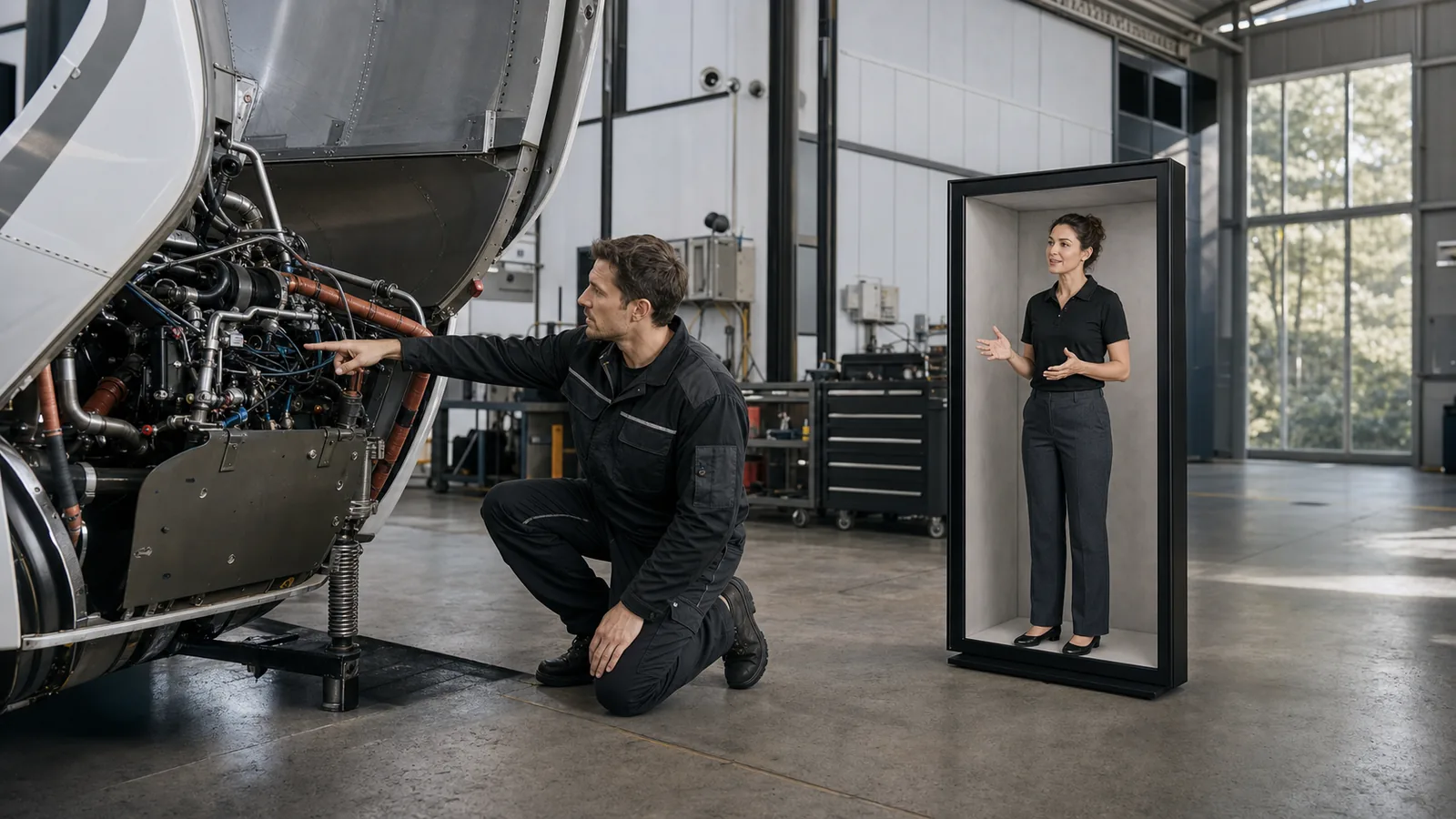
The first spatial-display project should not begin with a list of effects. It should begin with one moment where access, understanding or attention already carries measurable value.
What is the valuable moment?
Describe the moment before the technology. “A remote specialist guides a technician through the final alignment” is useful. “Install a hologram” is not. The first statement identifies a person, place, action and outcome; the second identifies only an effect.
Strong moments usually involve scarce expertise, difficult-to-understand form, emotional human access, premium attention or an intelligent system that needs a visible physical role.
Does the problem actually need spatial display?
Ask what fails when the experience becomes flat. If a product's mechanism, human gesture, viewing angle or physical scale disappears, the spatial layer is doing real work. If the same decision can be made from a normal video, a flat display is probably the better first implementation.
This filter protects the project from novelty-driven scope.
How should opportunities be scored?
| Factor | Low score | High score | Question |
|---|---|---|---|
| Value of the moment | Casual attention | Revenue, access, safety, learning or expert time | What improves if this works? |
| Spatial necessity | Flat media is equivalent | Depth, scale, gesture or viewpoint changes understanding | What is lost in 2D? |
| Repeatability | One-off spectacle | Frequent, recognizable workflow | How often does the moment occur? |
| Environmental control | Unknown light and traffic | Known placement, viewing distance and operator | Can the room be designed? |
| Content readiness | No rights or source assets | Approved person, 3D asset, video or data | Can we make a valid scene now? |
| Measurability | “People liked it” | Baseline and one observable outcome | How will we know? |
| Operational fit | Specialist required daily | Staff can launch and recover it | Who owns the experience? |
Which use-case patterns are strongest?
People
Remote experts, advisors, teachers, clinicians, performers or family members whose gaze, gesture and human scale matter.
Objects
Products, artifacts, anatomy, machinery and digital twins that benefit from cutaway, rotation, comparison or exploded form.
Intelligence
AI representatives, tutors and agents that need expression, context and a visible point of accountability in the room.
Environments can also be valuable, but they are easiest to misuse. A complete landscape that ignores the device's physical chamber may feel like ordinary video. Use an environment when it supports the subject and task, not simply to fill the frame.
What should the first pilot prove?
- 01
Experience
The intended person or object reads clearly across the agreed viewing zone.
- 02
Outcome
One metric improves against the existing process or flat-screen baseline.
- 03
Operation
Staff can start, switch, monitor and recover the experience.
- 04
Content
The approved scene can be updated without rebuilding the installation.
- 05
Decision
The evidence supports a clear scale, revise or stop conclusion.
Which metrics should you choose?
Retail might measure qualified engagement, assisted conversion or product comprehension. Remote expertise might measure resolution time, repeat visits or travel avoided. Education might measure task completion and recall. Museums might measure interpretation, dwell and accessibility. AI experiences might measure successful handoff, task completion and user trust.
Choose one primary measure and a small set of guardrails. A pilot cannot answer every strategy question at once.
Which projects should wait?
- The only objective is to “go viral.”
- No one owns the content rights or source quality.
- The target room and viewing conditions are unknown.
- The content requires a larger or different display than the planned endpoint.
- There is no baseline, outcome or operator.
- The concept depends on claims that have not been demonstrated on the exact system.
Waiting is not failure. It is cheaper than scaling an experience that has not earned a role.
What is the next practical step?
Write a one-page pilot brief: audience, valuable moment, spatial necessity, target place, approved content, primary metric, operator and stop condition. Then choose the optical endpoint and scene architecture that fit the brief.
Reality Relay's use-case library provides starting patterns across ten sectors. The framework on this page determines which one deserves to become real first.