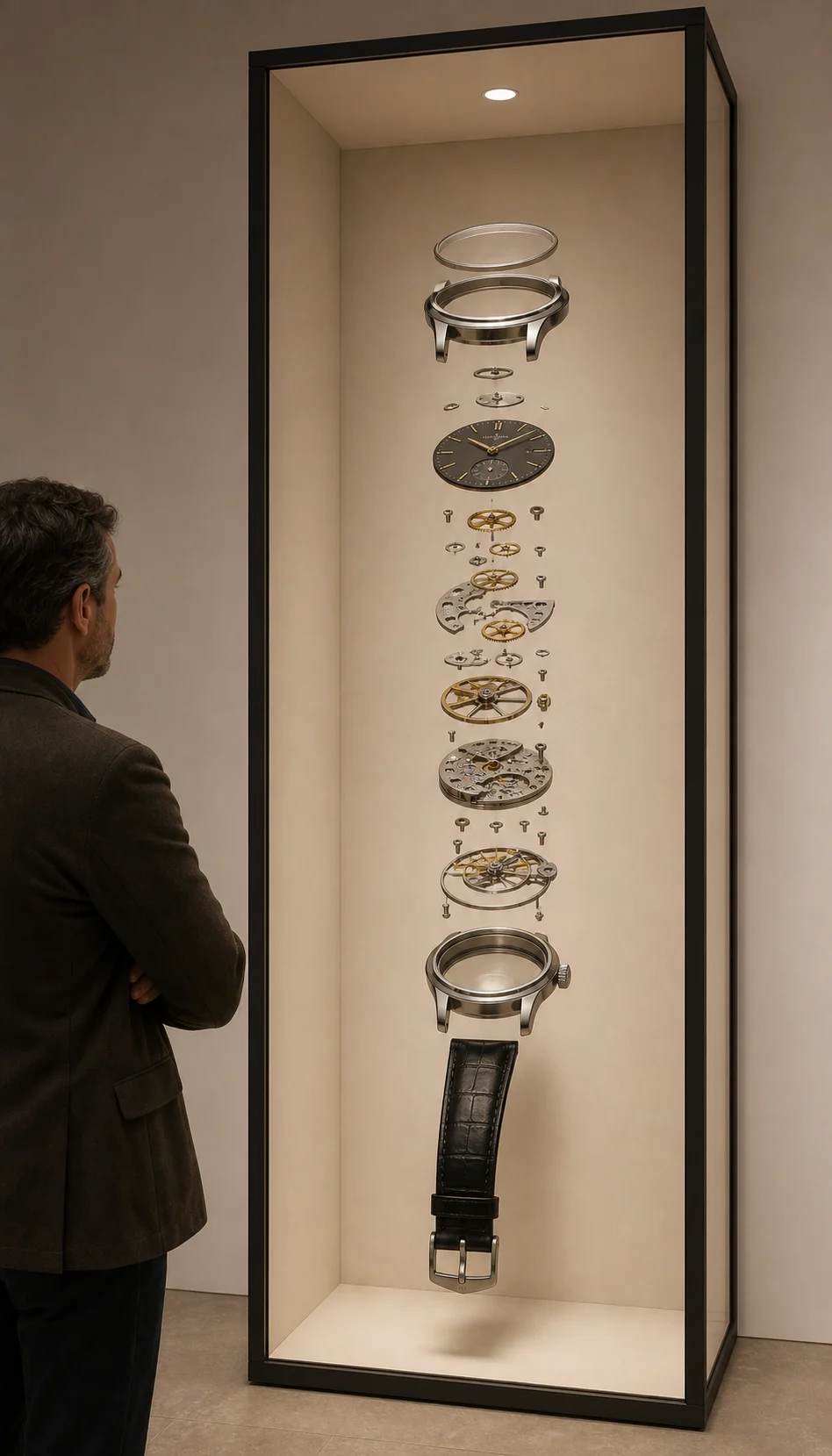
The word hologram is often used for almost any image that appears dimensional. The distinction matters because different display families produce different depth cues, viewing freedom and operating constraints.
Why are the words so confusing?
Popular language describes the effect; optical engineering describes the mechanism. If an image seems to float, occupy depth or respond to viewpoint, audiences often call it a hologram. Marketing adopted that convenient word for reflected stage illusions, transparent screens, spinning LED displays and multiview panels.
The problem begins when the label is used to imply technical properties the system does not provide. A buyer may expect free-viewpoint imagery, natural focus cues or a real image in open space when the product actually offers a controlled frontal composition. Precise language prevents that mismatch.
What is a hologram in the technical sense?
Holography records or computes information about a light wave and later reconstructs that wave through diffraction and interference. Unlike ordinary photography, a hologram is concerned with phase as well as intensity. A dynamic holographic display typically uses a spatial light modulator and a computed hologram to shape the outgoing wavefront.
That is a demanding problem. Field of view, image size, resolution and viewing freedom compete for a finite space-bandwidth product, while computation, color reproduction and speckle remain active engineering constraints.
What do non-holographic spatial displays do instead?
Autostereoscopic displays send different images toward different viewing positions. Light-field displays sample the directional distribution of light so views change across an angular field. Reflected-image systems redirect a conventional image into a designed physical chamber. Aerial imaging optics form a real image at an apparent location away from the source plane. Volumetric systems activate visible points inside a physical volume.
Each can produce a legitimate spatial experience without reconstructing a holographic wavefront.
How do the families compare?
| Question | Digital holography | Light-field / multiview | Reflected or aerial image | Volumetric |
|---|---|---|---|---|
| What is controlled? | Wavefront phase and amplitude | Directional views or ray samples | Image path and apparent image location | Visible points in a physical volume |
| Parallax | Potentially continuous | Discrete or quasi-continuous within a viewing field | Usually composition- and viewpoint-dependent | Natural around the lit volume, subject to occlusion limits |
| Common content input | Computed hologram from 3D data | Multiview renders, depth or quilt | Prepared video, live feed or rendered scene | Voxel or swept-volume representation |
| Primary product challenge | Modulator, computation and optical efficiency | View/resolution/brightness trade-off | Contrast, enclosure and alignment | Resolution, mechanics and occlusion |
Is Pepper's Ghost a hologram?
No. The classic Pepper's Ghost illusion uses reflection from an angled transparent surface to make a subject appear within another space. Modern stage and showcase systems may use advanced films, displays and carefully designed chambers, but the underlying reflected-image principle is not holographic wavefront reconstruction.
That does not make it inferior. It means it should be evaluated for what it actually does well: scale, brightness, composition, practical content and stage presence.
What language should buyers and brands use?
Use spatial display or glasses-free 3D display for the broad experience category. Then name the architecture when it is known: light-field, autostereoscopic, reflected-image, aerial, volumetric or holographic. Use “hologram-like” only when describing an audience impression, not a technical mechanism.
Reality Relay uses “spatial display” because its product direction can support multiple optical implementations while keeping the promise consistent: digital subjects are composed to feel situated in a bounded physical space.
What should you ask before buying?
- Which depth cues does the system reproduce?
- How large is the usable viewing zone, and for how many people?
- What happens when the observer moves off-axis?
- Is tracking required?
- What source format and content preparation are required?
- What ambient-light conditions are acceptable?
- Which claims have been demonstrated on the exact product configuration?
These questions reveal more than the word hologram ever will.