A memorable luxury appointment is rarely just about seeing an object. It is the quiet of the room, the story behind the piece and the feeling that someone understands what the client is looking for. Reality Relay is designed to protect that human ritual while giving the advisor access to pieces and people beyond the walls of the boutique.
A boutique is a conversation, not a catalog.
Campaign films and ecommerce pages can create desire. The boutique does something more intimate: it helps a person understand proportion, craft and meaning. Reality Relay gives an unavailable object a defined place in that conversation—a softly lit chamber where it can be seen at an honest scale, from the angles that matter, while the advisor stays beside the client.
It should never pretend that a representation is the physical piece. Leather should still be touched. Fragrance should still be worn. Jewelry should still meet the skin. Presence is the bridge that keeps curiosity alive until the real encounter can happen.
The boutique remains physical. The collection becomes larger than the room.
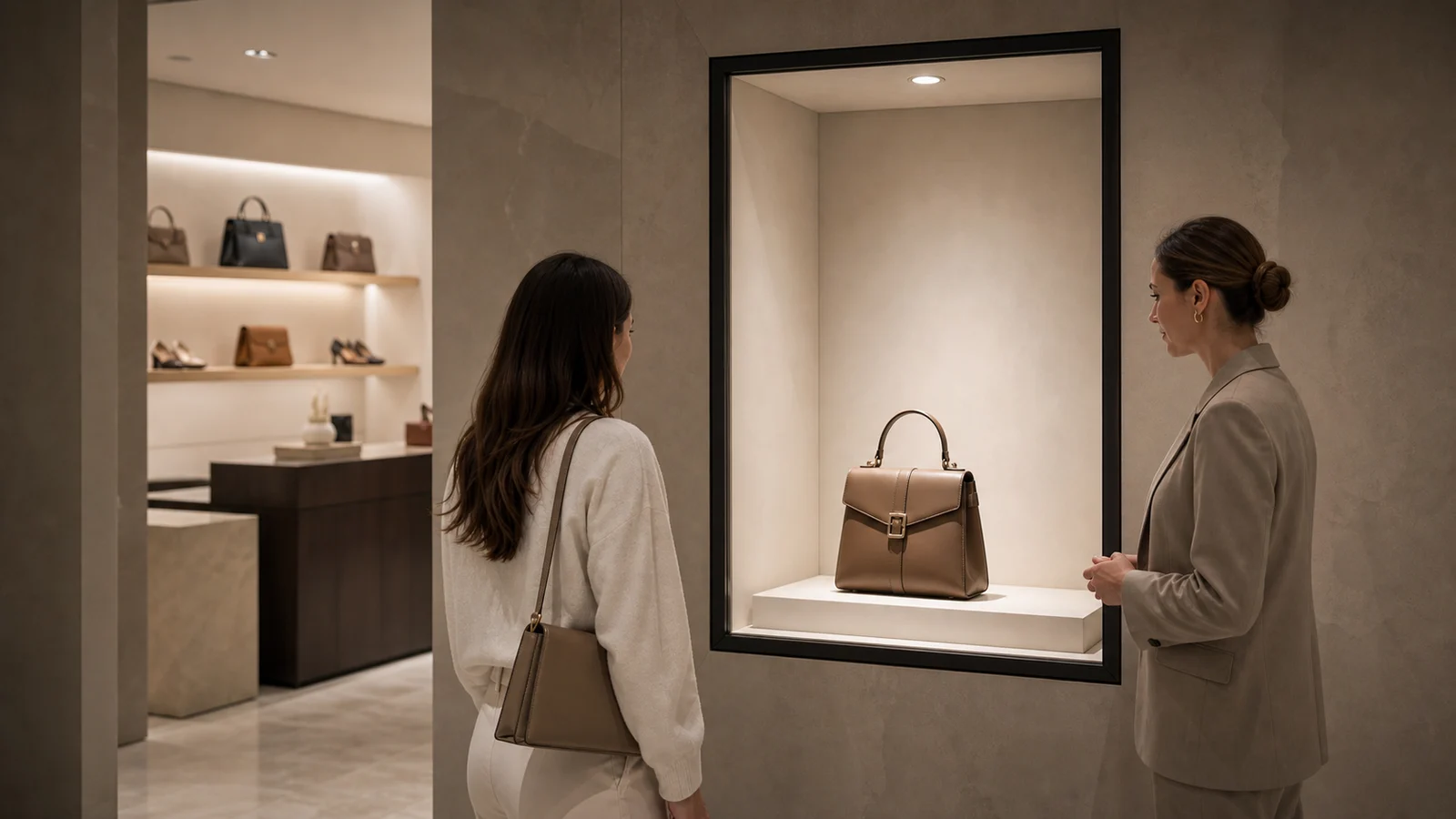
A handbag can enter the room before it arrives.
A client may know the silhouette but not the size, structure or relationship between handle, closure and body. A full-scale spatial handbag lets the advisor compare proportions, rotate the form, open an approved construction view and move between available materials. The experience is particularly useful for rare pieces, pre-launch appointments, made-to-order programs and stores that cannot carry every configuration.
The dimensional presentation should sit beside physical leather, hardware and color samples. Reality Relay expands the assortment while the advisor preserves material truth.
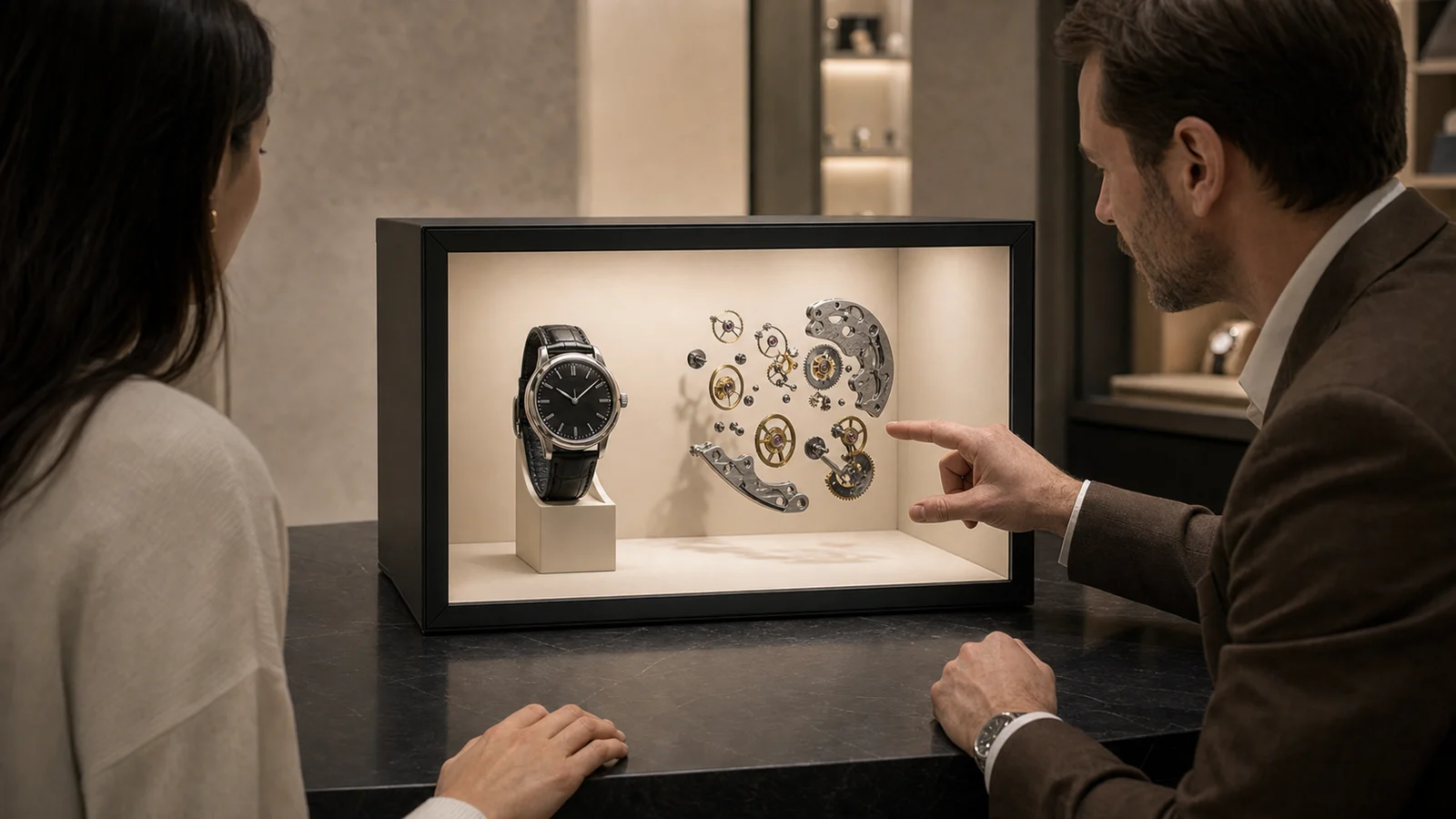
Let the client see why the watch matters.
A mechanical watch is physically small but conceptually dense. Much of its value is hidden under the dial or caseback. A compact chamber can keep the complete watch at one-to-one scale while placing an exploded movement, balance assembly or finishing detail behind it in a controlled spatial sequence.
This changes the conversation from specifications to understanding. A watch specialist can explain how energy moves through the caliber, why one bridge architecture differs from another and where hand finishing appears—without disassembling a valuable physical piece. A remote manufacture expert could join the same consultation when deeper knowledge is required.
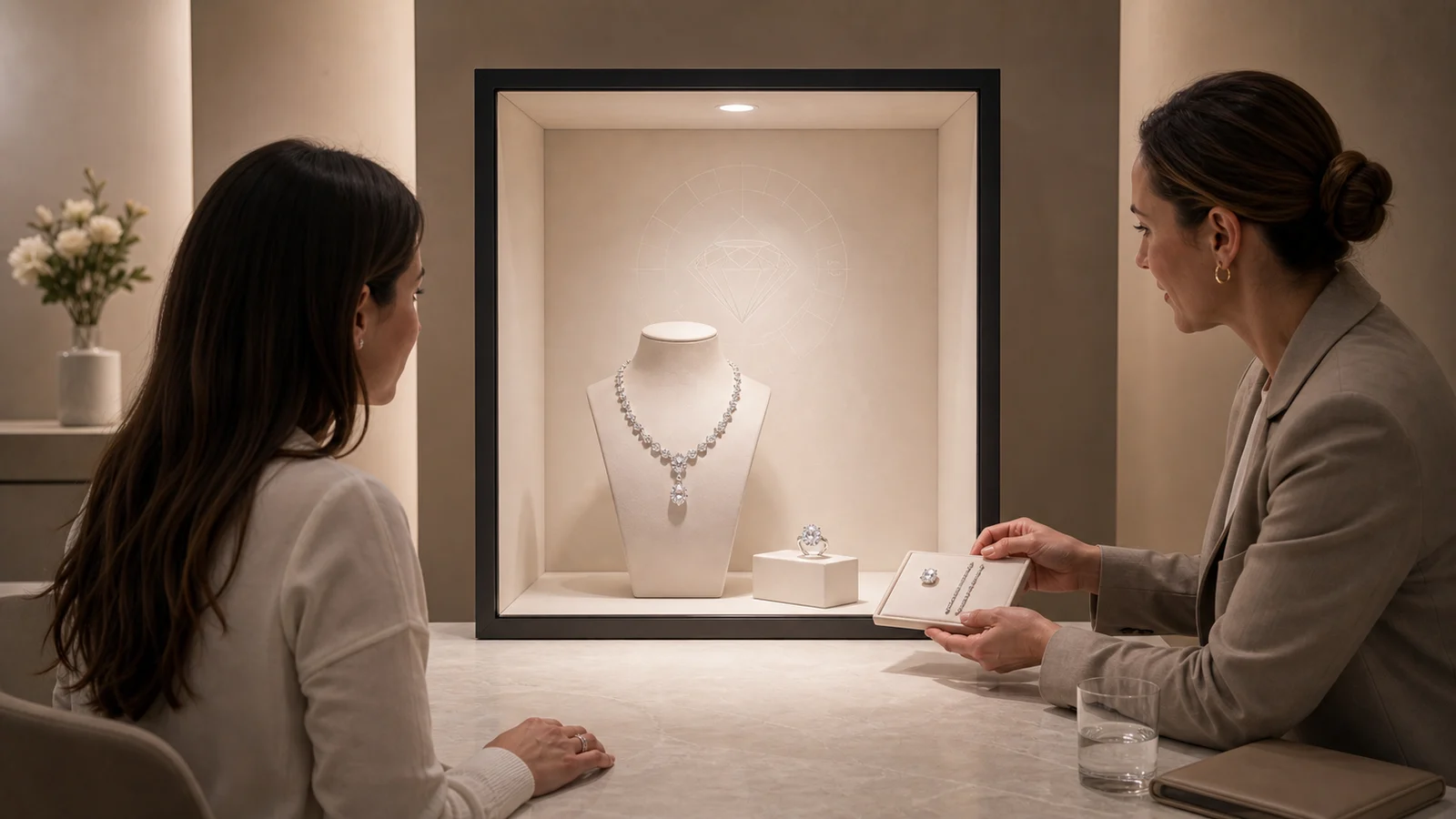
Private viewing can begin before the piece travels.
High jewelry depends on intimacy, trust and light. Spatial presence should not replace the moment when the client handles an approved piece. It can prepare that moment: present a reference that is held in another salon, compare stone arrangements, reveal setting construction or show the origin and cut logic of a gemstone alongside physical samples.
The chamber becomes a controlled private viewing stage. Product identity, scale and configuration should be tied to the brand’s authoritative asset and inventory record so the advisor never improvises around an outdated rendering.
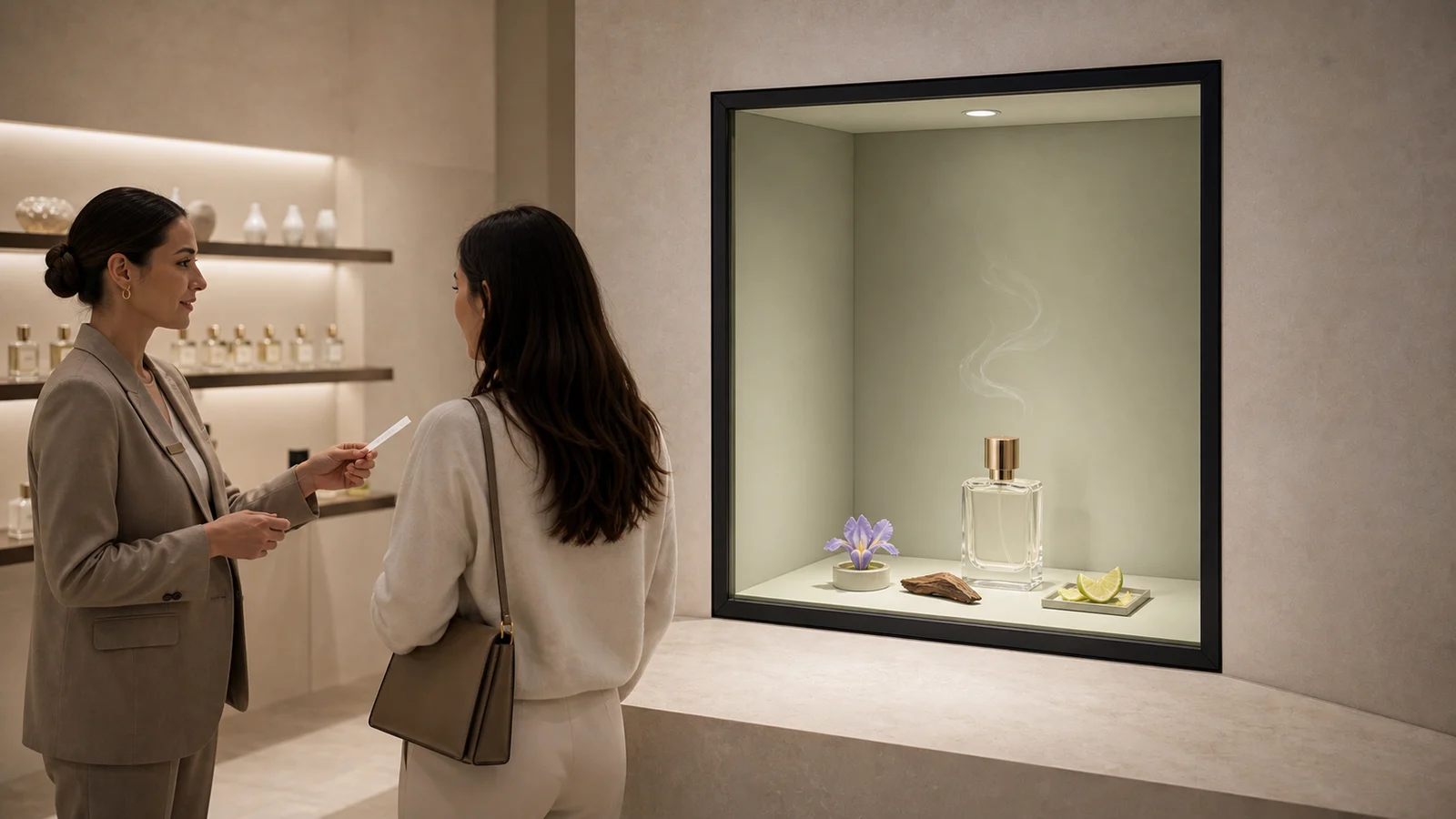
Give fragrance a visual language.
Fragrance is experienced through scent, yet its story is often delivered through flat ingredient photography. A dimensional scene can place the bottle, botanical sources and composition structure into one visual space while the advisor provides a real blotter or skin test outside it.
The contrast is important: the chamber explains; the physical sample proves. Spatial storytelling can distinguish ingredients, extraction methods, origin and evolution without pretending that imagery can reproduce scent.
Show the choice without crowding the shelf.
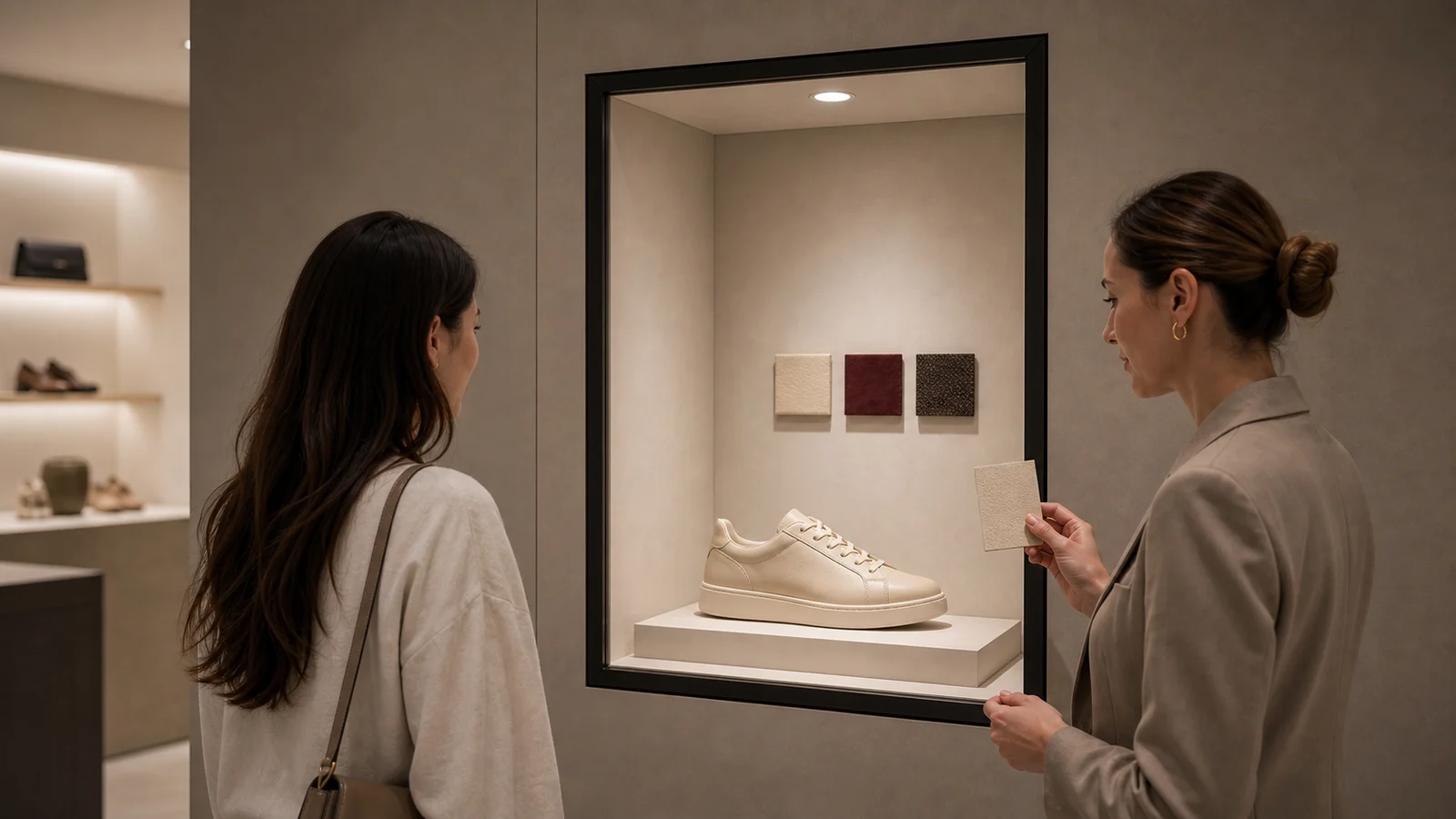
No store carries every size, material and seasonal color. A one-to-one dimensional shoe can extend the shelf into approved variants, made-to-order combinations and upcoming releases. Physical swatches remain outside the chamber for touch, while the spatial object shows how those materials change the whole silhouette.
The advisor can move directly from exploration to an inventory check, reservation, transfer or appointment. That connection to action is what separates dimensional commerce from visual novelty.
The advisor remains central.
Luxury clienteling is relational. The system should increase the advisor’s capability rather than compete for attention. Interaction can be deliberately simple: the advisor selects an approved product, moves between a small number of meaningful views, summons a remote specialist and records the client’s next action through existing clienteling systems.
A remote expert is especially powerful. One watchmaker, atelier representative or category specialist can serve appointments across several boutiques without appearing as another video-call rectangle. The expert occupies a dedicated presence endpoint and joins the conversation at the moment their knowledge carries value.
The technology should disappear into the service.
The house begins with an approved product asset: correct dimensions, materials, configurations and rights. Reality Relay prepares it for a calibrated consultation space. The advisor opens only the views that help the client—perhaps the movement inside a watch, the structure of a bag or the ingredients behind a fragrance.
Availability, reservation and appointment information should come from the systems the boutique already trusts. If a deeper question arises, the advisor can invite a remote watchmaker, atelier representative or category specialist into the conversation. No technical theatre. Just a more capable “let me find out for you.”
Material truth is a design requirement.
Luxury loses value when a digital presentation exaggerates color, scale, brilliance or finish. Every scene should state whether the product is shown at one-to-one scale. Displays require calibration across brightness, white point and viewing zone. Materials that cannot be represented reliably should be paired with a physical swatch. Product availability, provenance and configuration need direct operational authority.
These constraints make the system more valuable, not less. Trust is the difference between a campaign effect and a commerce platform.
Begin with one house, one boutique and a small collection.
The right pilot is intentionally personal. Choose a handful of pieces that advisors already struggle to show: a rare bag, a watch whose movement deserves explanation, a jewel held in another salon, a fragrance with a remarkable origin story. Build each experience with the people who actually sell and care for those objects.
Invite trusted clients into scheduled appointments. Listen to the language they use. Notice where the advisor reaches for a physical sample and where the spatial presentation opens a new question. Measure reservations, transfers, specialist conversations and follow-up—but also ask the human question: did this make the appointment more meaningful?
Exploration
Do clients engage with more of the approved collection without adding physical inventory?
Expert access
Do advisors connect the right specialist at the moment deeper knowledge matters?
Next action
Does the consultation lead to a reservation, transfer, appointment or qualified follow-up?
The strategic product is a presence-enabled collection.
The first installation may look like an extraordinary display. The platform opportunity is larger: one governed product asset can travel to boutiques, private salons, events, hotel suites and temporary stores while preserving scale, story and permissions. Remote experts can travel with it. Updates can reach every approved endpoint without rebuilding the physical installation.
That creates a new layer between ecommerce and inventory-heavy retail—a physical consultation surface for products that are valuable precisely because access is limited.
An open invitation
Build a consultation people remember.
Bring us one meaningful product and the ritual your best advisors use to present it. We will shape the first Reality Relay experience with your retail, creative and clienteling teams.
Create the first experience with us ↗