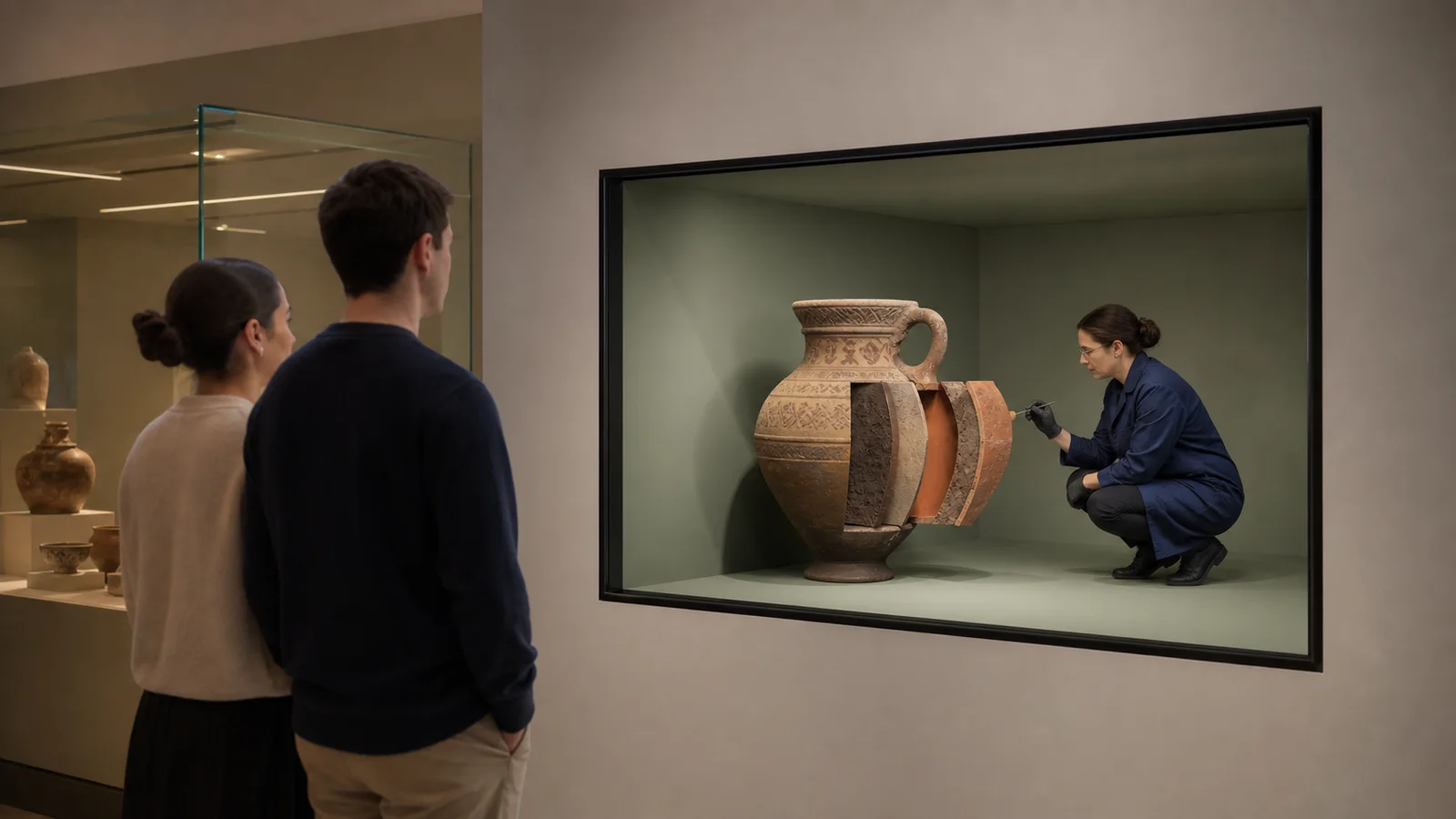
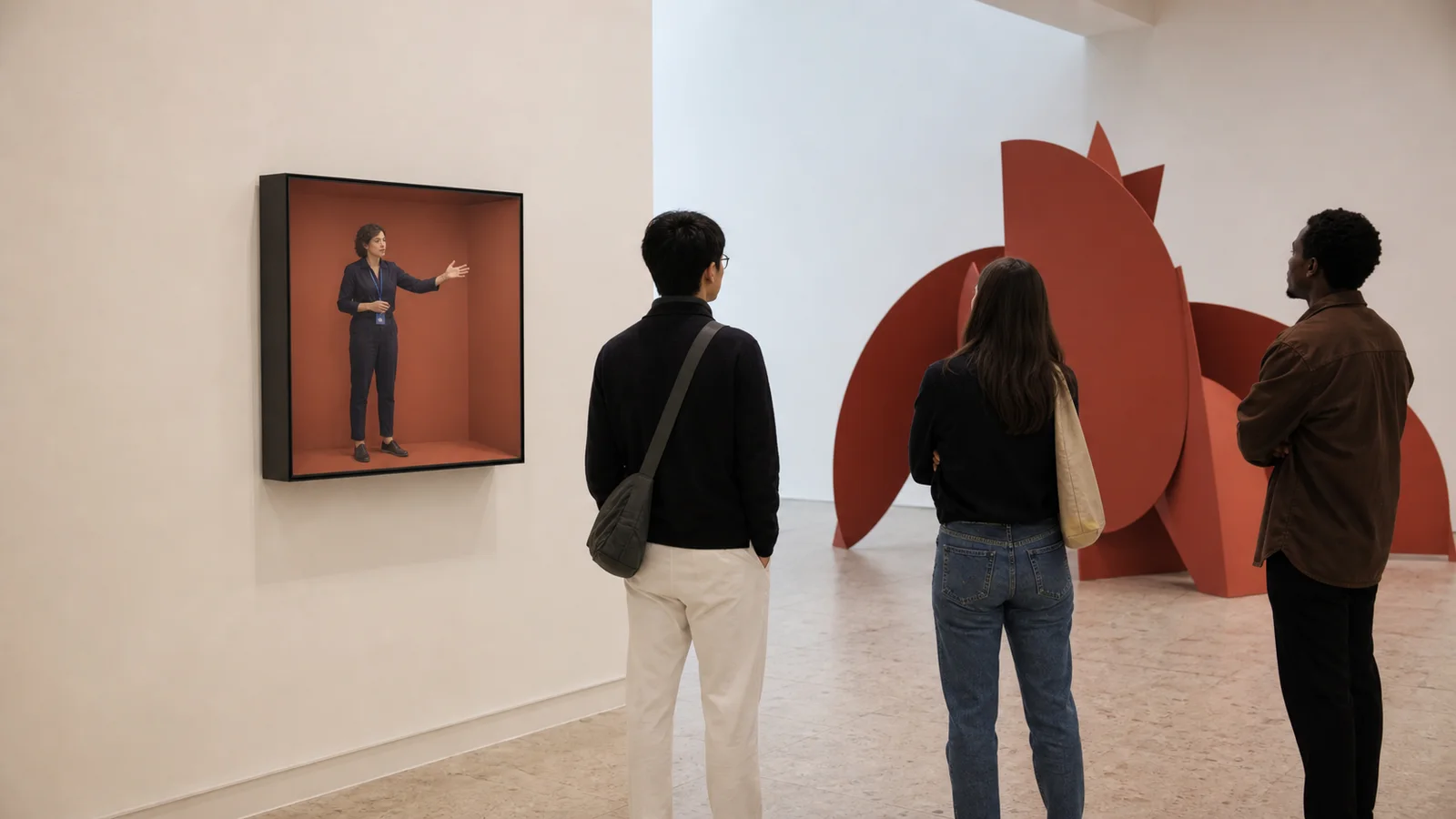
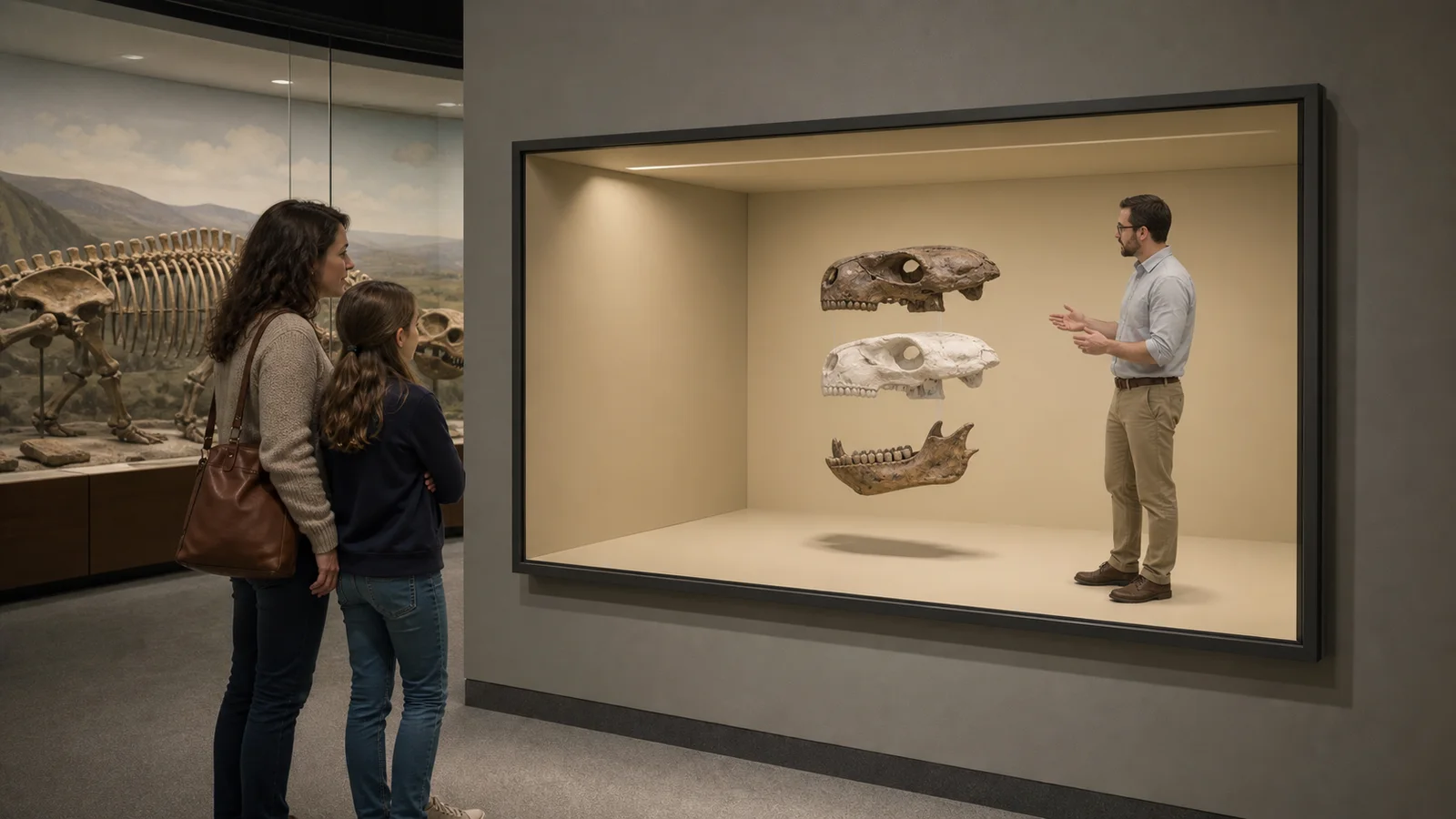
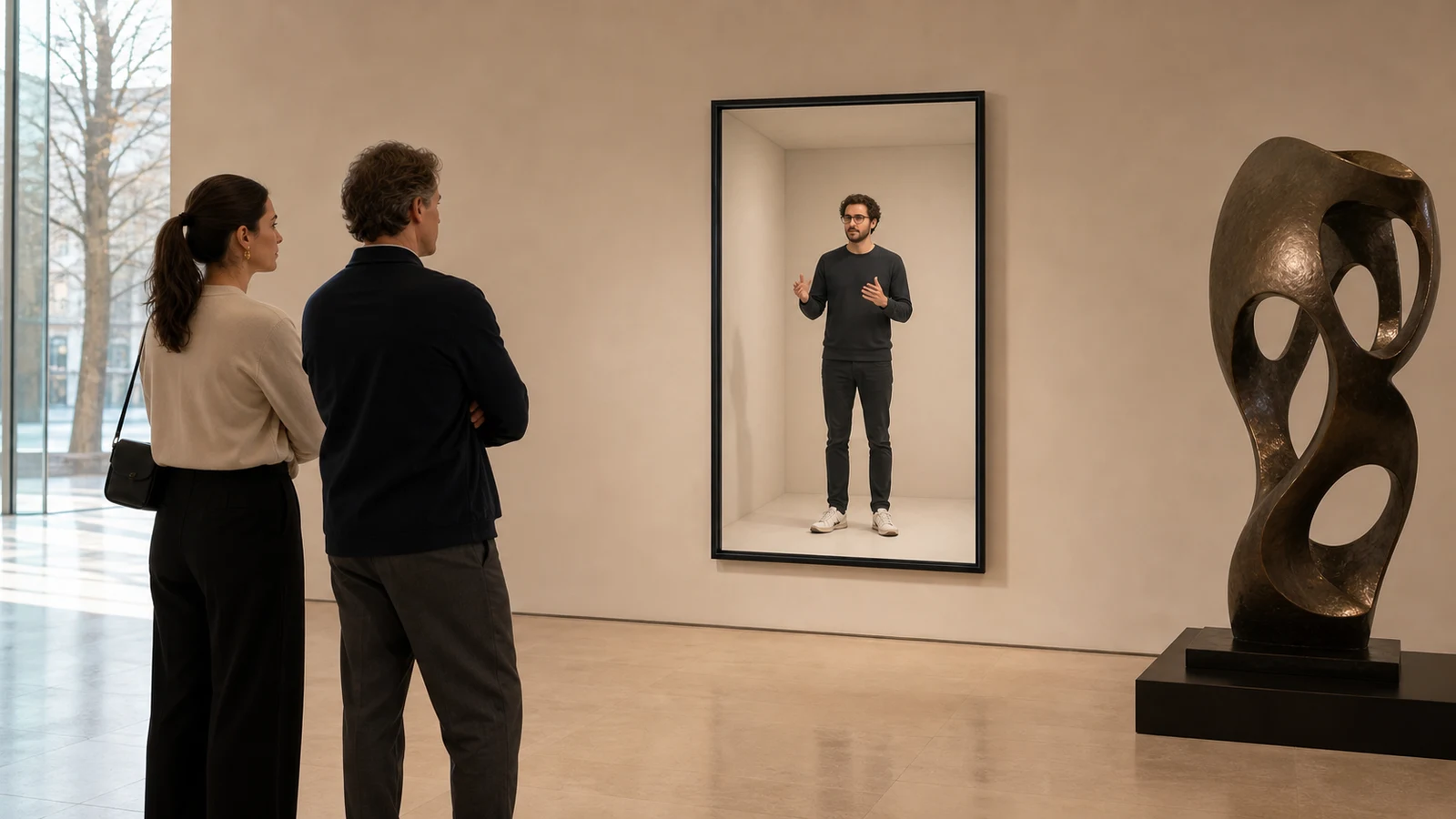
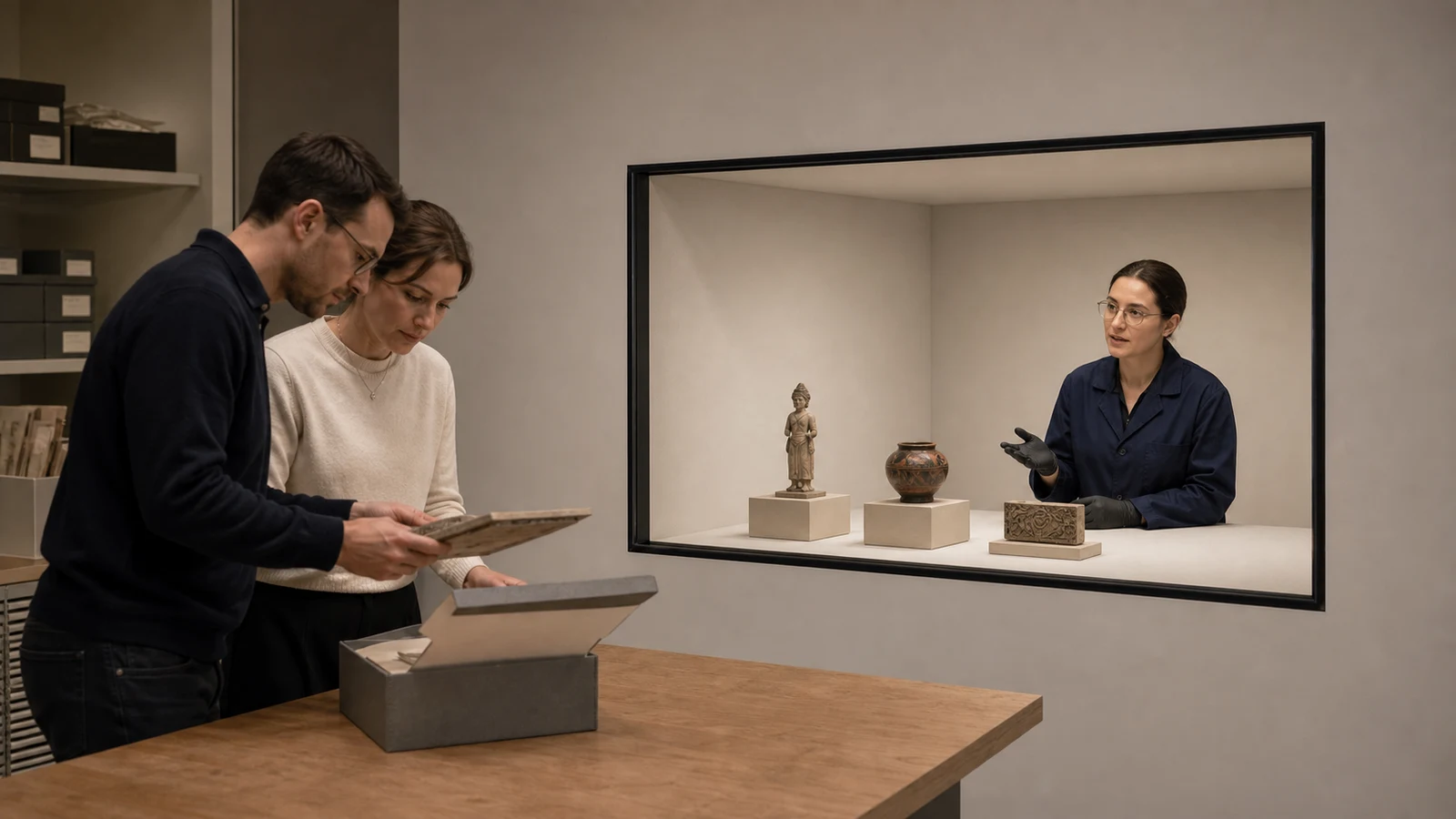
A label must serve everyone at once. An audio guide separates visitors from companions. A conventional screen often becomes another object competing for attention. Reality Relay offers a more focused pattern: one bounded optical chamber that situates a docent, conservator or dimensional reconstruction near the collection without pretending to replace it.
One presence layer across the museum.
The same calibrated endpoint can support a scheduled curator conversation in one gallery, an evidence-based reconstruction in another and a remote collections review behind the scenes. The value is not the number of visual effects. It is a consistent operating surface that can receive approved people, objects and interpretive scenes without forcing every department to invent a separate display system.
Four modes of museum presence.
-
01
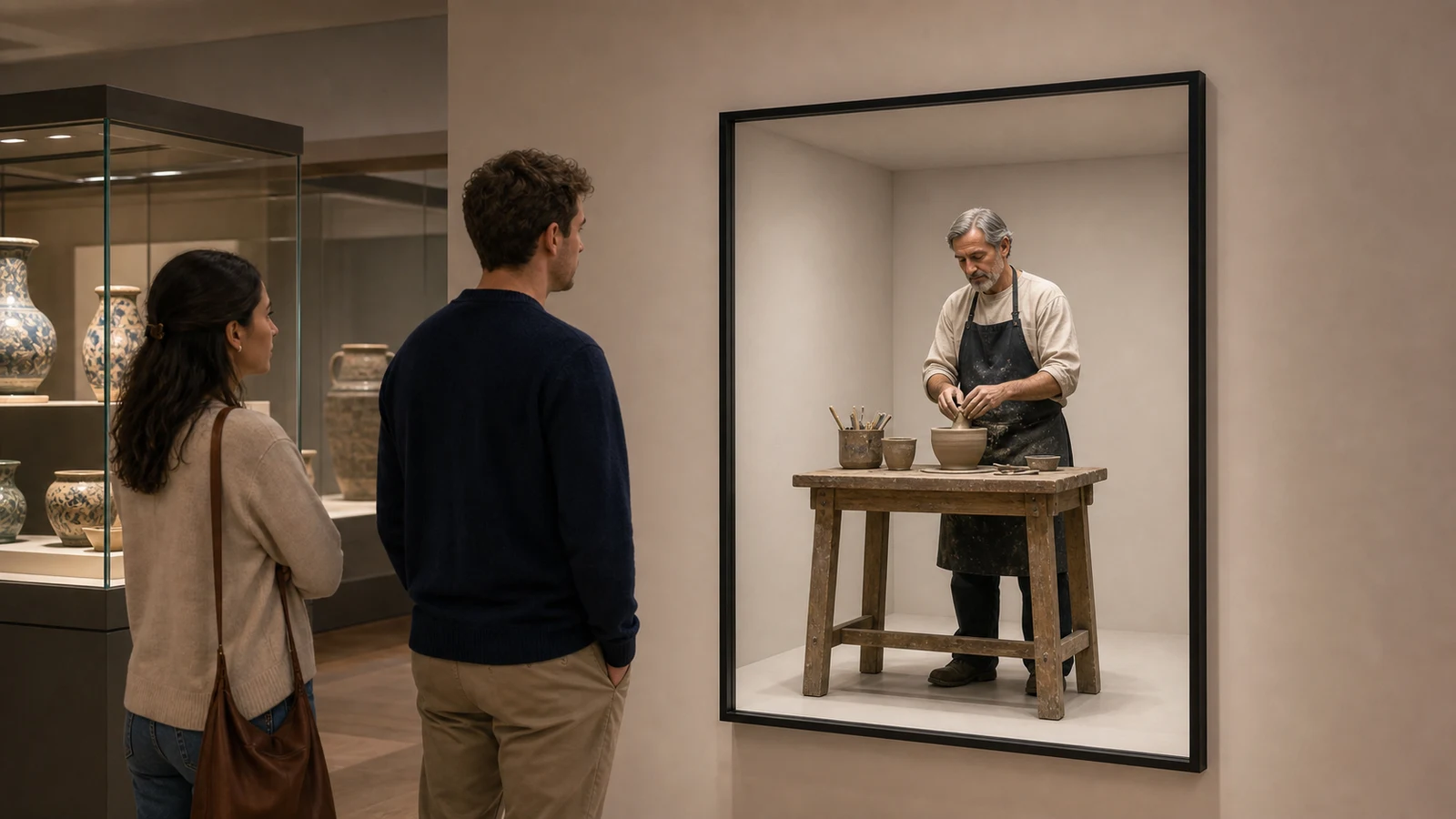
Remote interpretation
A curator, artist, maker or community expert can join a scheduled gallery conversation at a useful scale without turning the room into a conventional video conference.
-
02
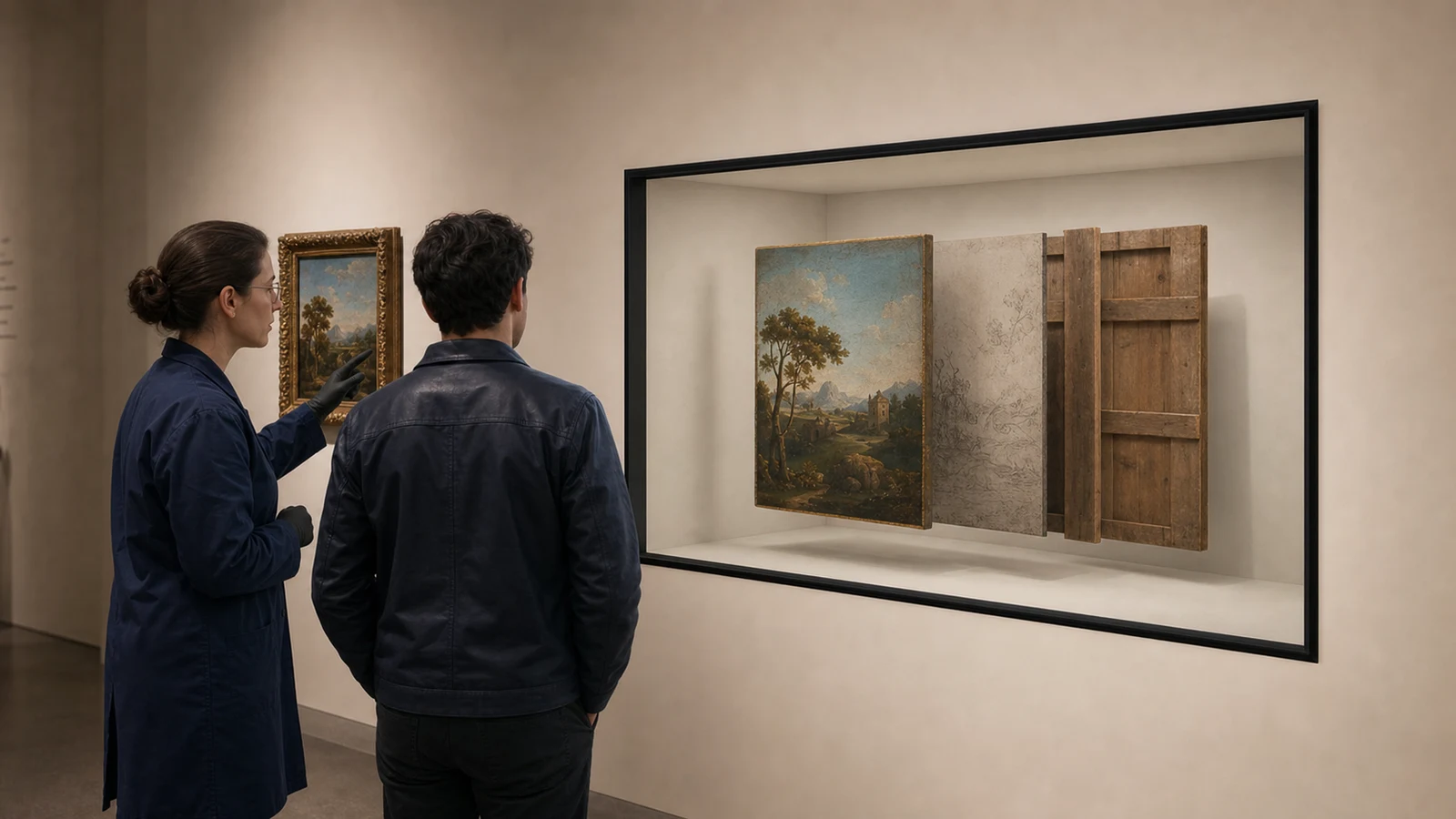
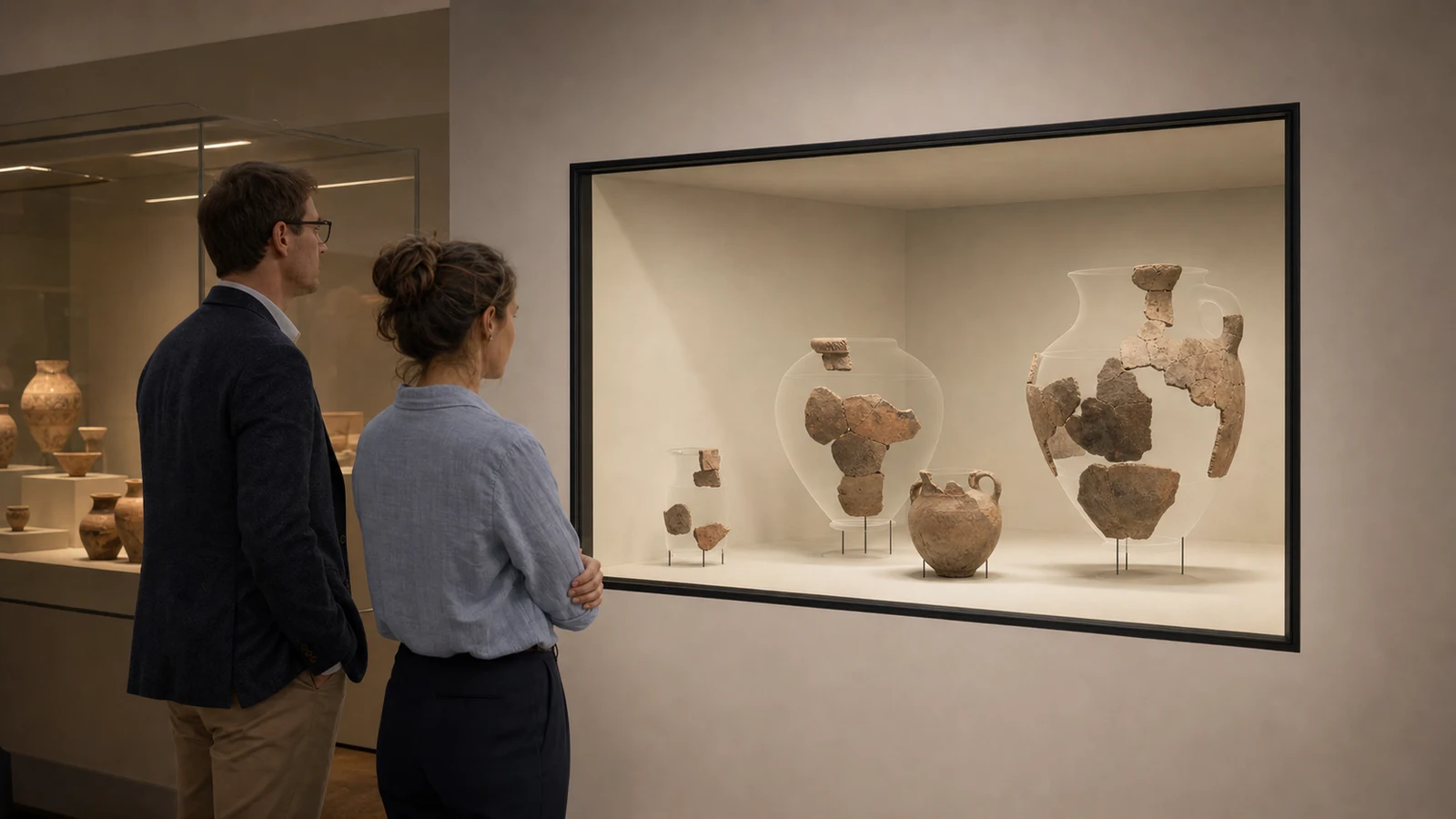
Dimensional reconstruction
Missing geometry, material layers and conservation evidence can be compared with the physical object while assumptions and uncertainty remain explicit.
-
03
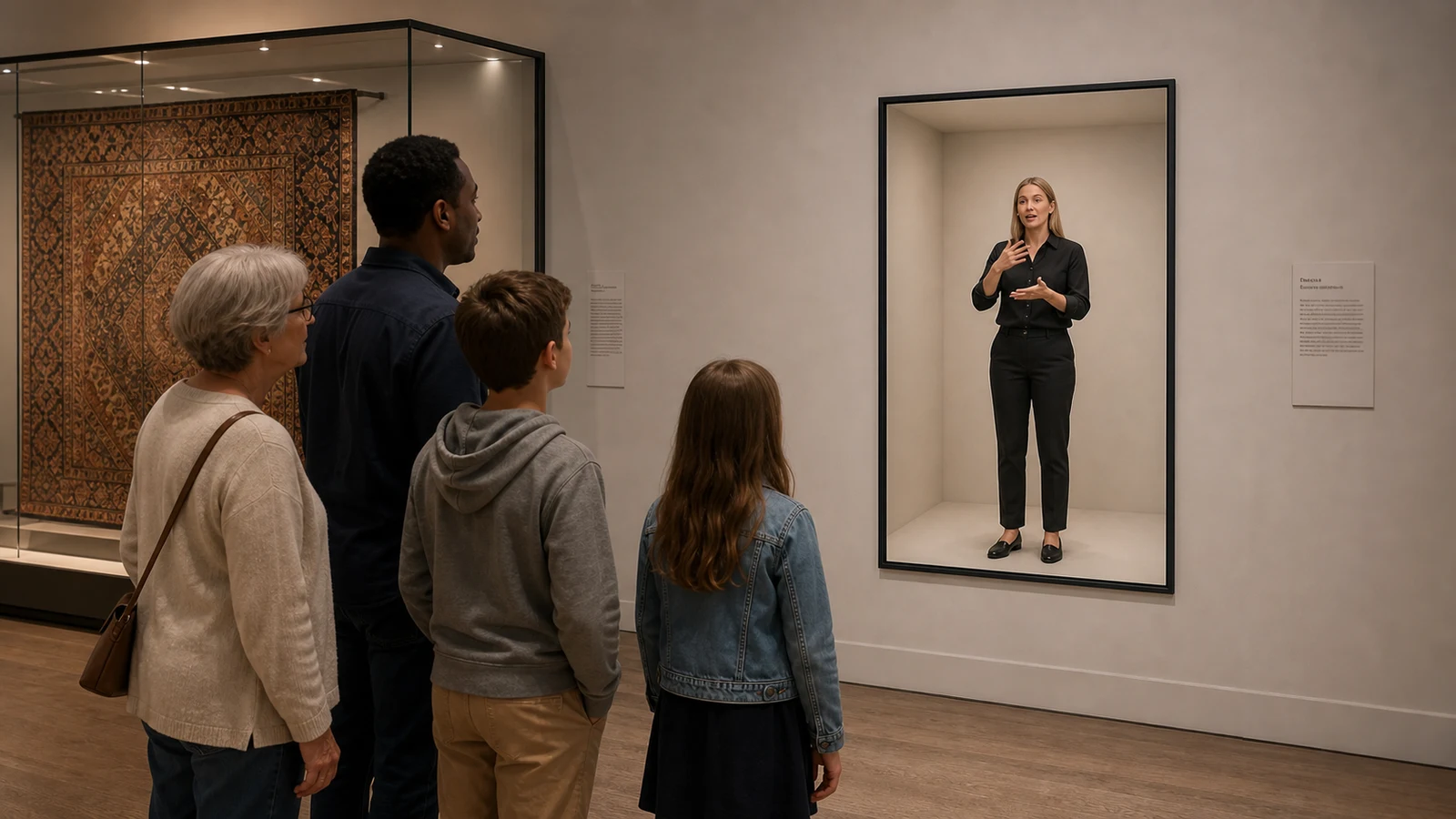
Adaptive access
Approved multilingual, signed and age-aware interpretation can respond to a group while keeping source attribution and human escalation intact.
-
04
Collections access
Researchers, educators and the public can examine rights-cleared objects or fragile material from storage while a qualified collections professional remains part of the encounter.
Interpretation becomes a live relationship.
Museum knowledge is distributed across curators, conservators, artists, historians, scientists and source communities. Most of those people cannot stand beside every object every day. A presence endpoint creates a scheduled place for that expertise to arrive. Visitors can ask a question, compare evidence and continue looking at the real collection rather than dropping into a separate device.
Reconstruction must show its evidence.
Dimensional content is most useful when it reveals how an interpretation was built. A fragment can align with proposed missing geometry. A painting can separate into surface, underdrawing and support. A fossil can be compared with a bounded reconstruction. Each scene should distinguish observation from inference and link back to the institution's approved sources.
Access is more than translation.
Signed interpretation, remote specialists, adjustable pacing and shared group viewing can improve access without isolating visitors. The museum remains responsible for language quality, disability access, cultural protocol and the right moment to transfer the conversation to a human. Presence should widen participation while preserving institutional accountability.
The collection remains the authority.
A credible experience points attention back to the original object and the institution's evidence. It does not fabricate provenance, impersonate a historical person without disclosure or turn the chamber into spectacle. The best test is simple: after the intervention, do visitors understand the collection better and return their attention to it?
What a responsible pilot should prove.
Begin with one gallery, one interpretive question and one accountable content owner. Measure comprehension, meaningful questions, dwell quality, accessibility, expert utilization, operating effort and system reliability. Record what visitors believed was real, reconstructed or remotely transmitted. A successful pilot should produce an authoring template and governance model that another gallery can reuse.
Museum application study
Choose one gallery and one interpretive question.
Reality Relay is inviting museums, cultural institutions and experience teams to design a source-aware presence pilot.
Start a pilot conversation ↗