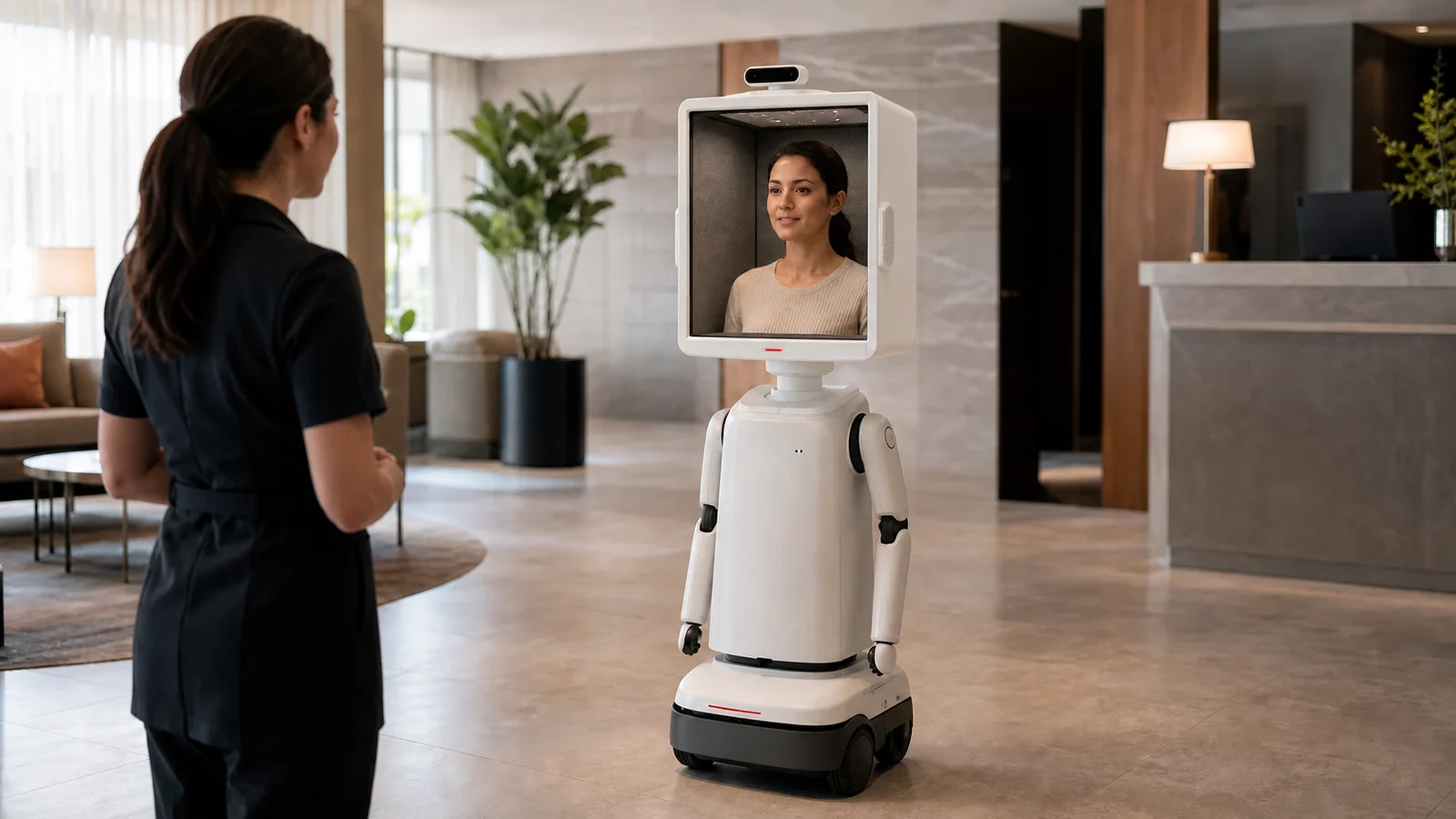
Robotics has spent decades making machines move through the world. The next challenge is making their intelligence legible. A robot can navigate perfectly and still feel socially absent. A small spatial chamber—roughly ten to twelve inches across—could turn the head from a fixed piece of industrial design into a programmable presence layer.
The head is not decoration.
People look to a head for gaze, turn-taking, attention, emotion and intent. Industrial robots often communicate through indicator lights, a simple animated mouth or a conventional screen. Those interfaces are robust, but they offer a narrow expressive vocabulary. A mechanical face can be more embodied, yet it also commits the product to one anatomy and adds actuators, linkages, acoustic noise, weight, wear and maintenance.
Relay Head proposes a different trade. Keep the robot’s perception hardware outside the image volume, where stereo or depth cameras can remain calibrated and safety-rated. Place a bounded optical chamber below those sensors. Inside it, render a person, an AI character or a functional identity with coherent depth, gaze, speech and motion. The chamber is not intended to masquerade as a biological head. It is a clearly designed place in which intelligence becomes present.
A mechanical head gives the robot a face. A spatial head gives the robot a cast.
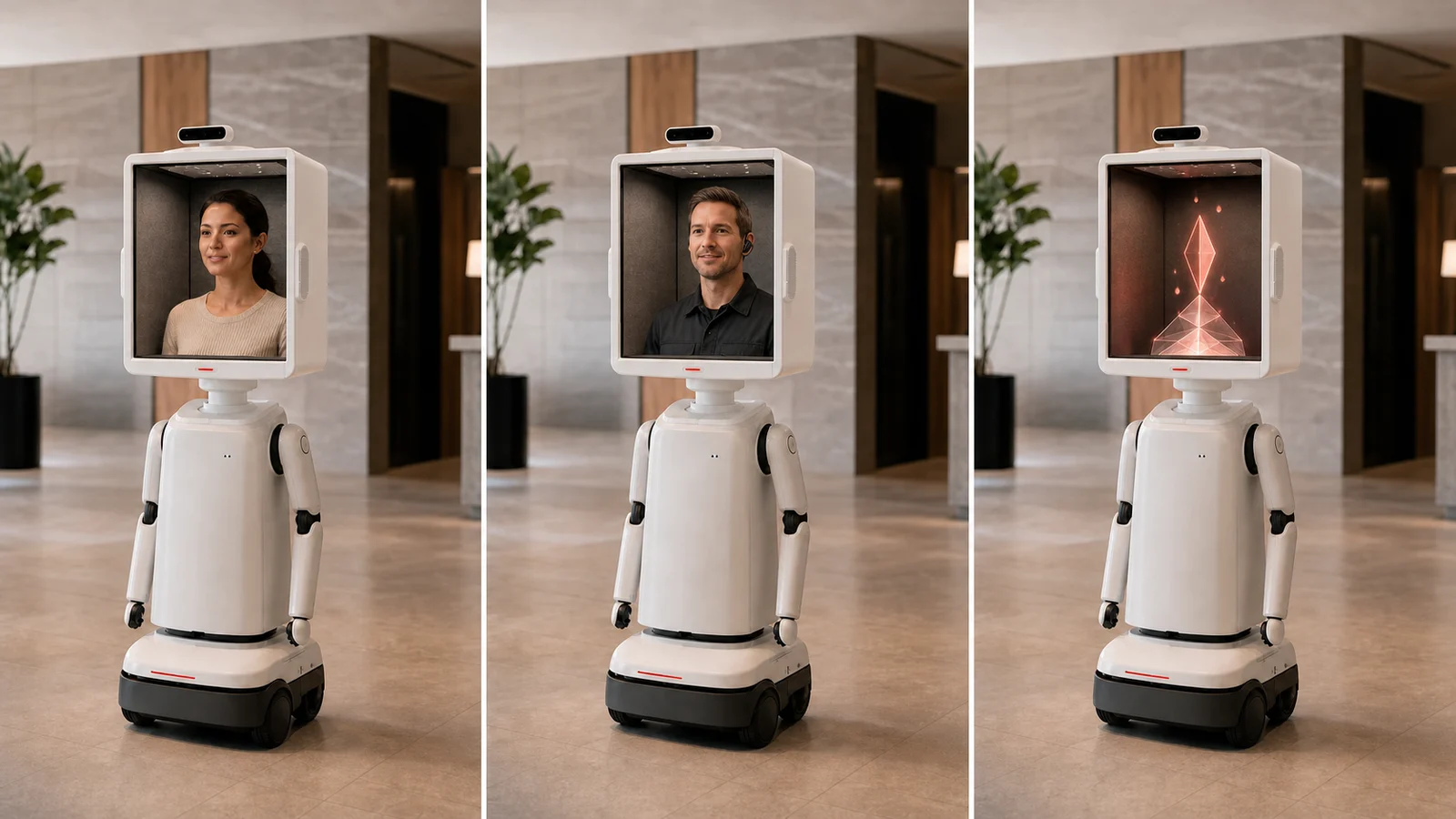
One body can serve many roles.
A hotel robot could begin the morning as a multilingual concierge, become a remote maintenance specialist when an elevator reports a fault, and switch to a branded event host in the evening. A hospital logistics robot could display a calm wayfinding guide, then hand the encounter to an authorized remote staff member. A retail robot could embody a product specialist for one launch and a different character for the next without replacing the machine.
The transition must be explicit. Users should always know whether they are speaking with AI, a live human or a scripted character. A persistent identity signal, a clear handoff animation and an independent physical safety indicator can prevent the interface from becoming deceptive. The advantage is not disguise; it is legible, rapid role change.
Why this can outperform a fixed mechanical face.
“More advanced” should not mean more theatrical. Mechanical expressions remain valuable when tactile geometry, eye contact across very wide angles or operation in extreme lighting is essential. But a spatial chamber offers a potentially more scalable form of expression: no facial motors to reconfigure, no single skin or morphology, and no need to manufacture a new head for every persona, language or market.
The same optical volume can support photorealistic telepresence, stylized AI characters, diagrammatic status views and non-human forms. Lip synchronization, eye direction and expression can update in software. A remote operator can inhabit the endpoint without their face being flattened into an ordinary video rectangle. The robot’s neck still provides physical pan and tilt, so spatial attention remains visible to people nearby.
Furhat shows why embodied conversation matters.
Furhat Robotics already demonstrates the value of an expressive, back-projected robotic face with real-time expressions, lip synchronization, sensing and three-axis head movement. That makes Furhat a natural technical conversation partner, not a product to dismiss. A Reality Relay module could explore a complementary direction: a deeper bounded chamber, identities that are not constrained to a human-shaped mask, and a direct visual mode for remote-human escalation.
The useful experiment would compare conversational clarity, gaze, identity switching and operator embodiment—not simply image novelty. Furhat’s experience in social interaction and Reality Relay’s spatial-chamber approach address adjacent layers of the same problem.
Apptronik could make the social layer optional.
Apptronik’s Apollo 2 uses an expressive LED mouth, coordinated lighting, speech and listening; Apptronik has also described digital face and chest panels as communication surfaces. That restraint makes sense for industrial work. A spatial head should not replace a robust minimal interface on every warehouse robot.
It could instead become an optional customer-facing module for hospitality, healthcare navigation, retail and remote service. The same mobile or humanoid platform could retain its industrial head for production work and use a Relay Head variant where trust, explanation and human escalation materially affect the task. The value proposition is product-line expansion without redesigning the entire body around a mechanical face.
Wehead is the closest conceptual neighbor.
Wehead describes a spatial-video device with a face-shaped display, dynamic head movement, microphones and speakers that move with the head. It already validates a central premise: a remote or synthetic presence becomes more compelling when image, motion and sound occupy a head-like physical location.
Reality Relay’s proposed contribution is a smaller OEM-oriented bounded chamber, a calibration and rendering runtime, identity switching, embodiment APIs and distribution across a fleet. A collaboration could test whether that stack transfers from a desktop conversational device into a manufacturable robot module.
The system is more than a display.
- 01
Bounded optical chamber
A thin, body-matched enclosure defines a real volume with visible inner walls, floor, ceiling and rear plane. The imagery is calibrated to that volume so the character appears situated inside it rather than pasted onto glass.
- 02
Independent perception
External RGB, stereo or depth sensors preserve the robot’s perception geometry. Safety-critical sensing never depends on the rendered character.
- 03
Embodiment runtime
The software aligns voice, lip motion, gaze, turn-taking and head orientation. It can route the endpoint among an AI model, an authorized remote human and deterministic functional states.
- 04
Physical articulation
A quiet two-axis neck directs the complete chamber toward a person or task. The virtual identity and physical head motion share one attention model.
- 05
Fleet identity layer
Approved characters, languages, permissions and brand states can be versioned and deployed across compatible robots without changing their mechanical bodies.
The hard engineering questions are knowable.
A credible product must control head mass and center of gravity, optical brightness, viewing zone, thermal load, power draw, camera-to-eye alignment, latency and lip synchronization. It must remain readable while the robot moves, survive cleaning and impact, avoid an uncanny mismatch between voice and face, and degrade safely if the network or rendering process fails.
Safety communication must remain independent of the virtual identity. Emergency stop, motion state and fault conditions need unambiguous physical indicators. The chamber should never conceal who—or what—is controlling the interaction. These constraints are not reasons to avoid the idea; they define the prototype that is worth building.
Start with a wheeled service robot.
The first pilot should use a slow indoor mobile base rather than a walking humanoid. Integrate one ten-to-twelve-inch Relay Head, two-axis neck, external depth sensing, microphone array and directional speaker. Test three modes: AI concierge, live remote expert and branded non-human character. Ask the robot to greet, provide wayfinding, explain a product or process, transfer to a human and recover clearly from lost connectivity.
Measure whether people recognize the active identity, follow gaze, understand handoffs, complete tasks and trust the system appropriately. Measure operator presence, end-to-end latency, thermal behavior, optical visibility and head stability. The pilot succeeds when rapid character switching improves usefulness without weakening safety or making the robot harder to operate.
The larger opportunity is an embodiment standard.
If many robots can host the same calibrated chamber, presence becomes portable. A certified expert could enter a hotel robot in one city and a service robot in another. An AI character could move across fleets while preserving voice, behavior and visual identity. Robot makers would continue to own locomotion, manipulation and safety; Reality Relay would supply the visible, conversational and remotely inhabitable layer.
That is the strategic reason for Furhat, Apptronik, Wehead and other robotics teams to explore the technology. It is not merely a nicer face. It is a way to separate the enduring machine from the identity that occupies it—and to let people, AI and characters share the same physical endpoint.
Technology proposal
Build the first Relay Head pilot.
Reality Relay is inviting robotics, teleoperation and physical-AI teams to test a compact spatial presence module on a real service platform.
Start a pilot conversation ↗