Live performance
encore.
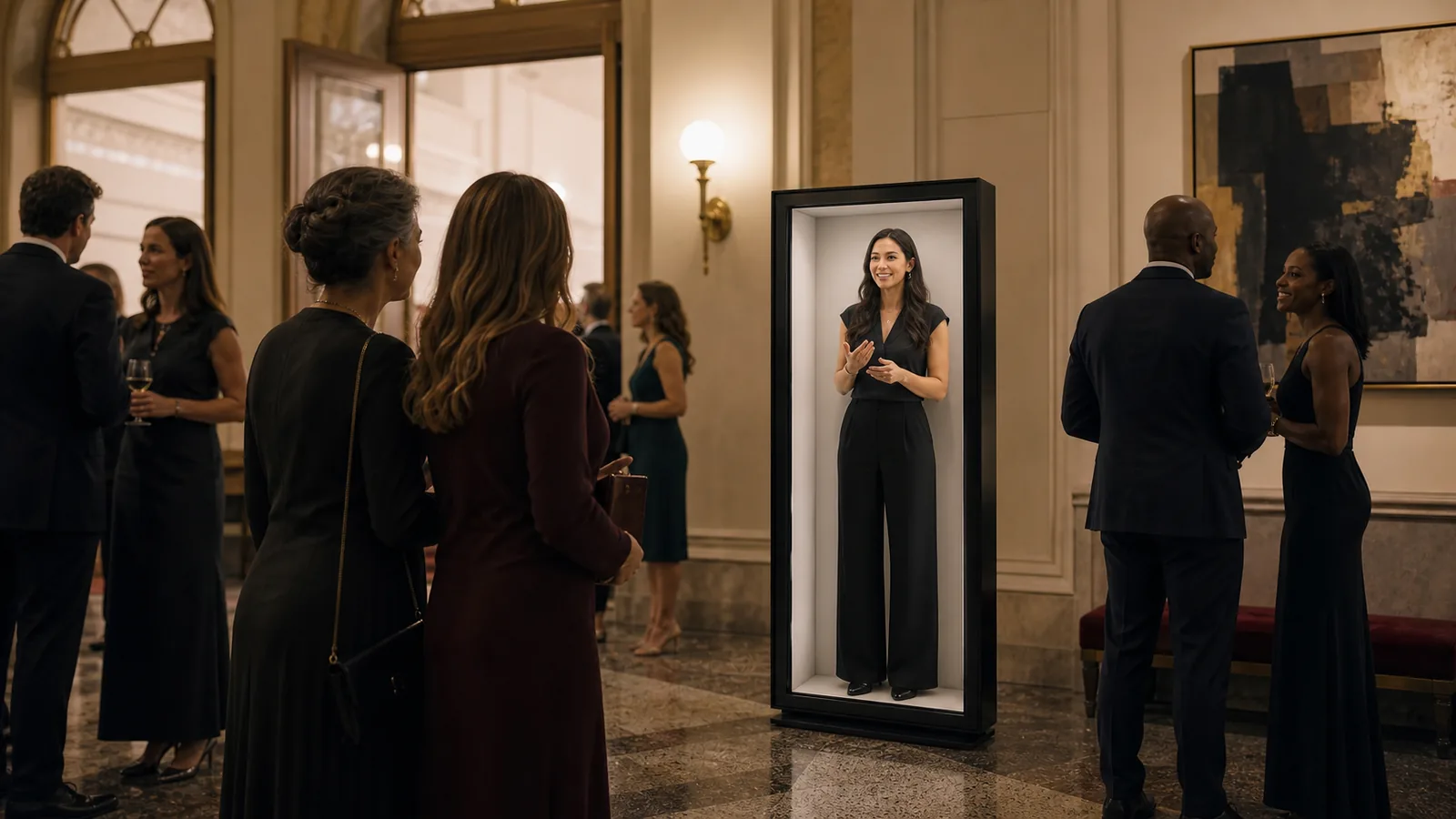
Extend a live artist into additional rooms or cities without presenting a remote feed as the same thing as attendance.
At a glance
Three decisions that shape the use case.
- 01
A live encore should extend the relationship between performer and audience while preserving rights, liveness and the integrity of the original event.
- 02
Use a screen or recording when the content does not benefit from acknowledging the room. Use presence when scale, eye line, live response or spatial relation changes interpretation.
- 03
The pilot should define a baseline and measure audience retention, paid attendance and performer interaction before anyone treats the concept as proven.
The opportunity
Design for the moment that matters.
What breaks today
Demand, travel and venue capacity limit access. Standard livestreams reach more people but lose the social and spatial focus of a performance.
The presence pattern
A disclosed remote performance occupies a dedicated stage-like Space with aligned sound, lighting and audience ritual, followed by live acknowledgment or conversation.
Design requirements
Make it useful before making it magical.
- 01
Frame the encounter
Make clear whether the presence is live, recorded, synthetic or interpretive.
- 02
Honor the work
Use technology to deepen attention to the artist, performance or object rather than replace it with an effect.
- 03
Design the ending
Return the visitor naturally to the collection, performance, community or next action.
Operator runbook
Design the complete service—not only the scene.
- 01
Set the baseline
Before launch, define the audience, room, and baseline event this presence changes. Name the owner of each session state and the handoff path.
- 02
Invite with clarity
For the first pilot, make the purpose explicit: why this presence is there, what it can do, whether it is live or AI-assisted, and how a participant exits safely.
- 03
Close the loop
A disclosed remote performance occupies a dedicated stage-like Space with aligned sound, lighting and audience ritual, followed by live acknowledgment or conversation. End every session with a visible next action, capture only consented outcomes, and run one short review before expanding to a second site.
Pilot scorecard
Prove a real outcome in the room.
Audience retention
Define the starting event, completion event and current-workflow baseline for audience retention. Count only observable outcomes.
Paid attendance
Review paid attendance by audience, session stage and operator. Use the pattern to find where confidence is gained or lost.
Performer interaction
Set a minimum threshold for performer interaction before launch. Name the owner and recovery action when a session misses it.
Decision gates
Know when presence is—and is not—the answer.
Presence must earn the room
If the same live performance encore outcome can be achieved by a well-designed phone, kiosk or conventional video call with equal trust and clarity, use the simpler tool.
The boundary must stay visible
Do not launch live performance encore until participants can identify the role, source, live or synthetic state, information boundary and human fallback without guessing.
The operation must survive novelty
Performing-arts venues and touring producers should be able to run, pause, recover and measure the experience repeatedly. Do not scale while success depends on a founder or engineer standing beside it.
Evidence status. This page is a product-design field brief, not a claim that Reality Relay has already produced the stated customer outcome. Replace the hypothesis with measured pilot evidence before presenting it as proof.
Build the first pilot
Start narrow enough to learn.
For Live performance encore, begin with one real environment, one defined audience and one repeatable interaction. Establish who operates the experience, what information or tools it can access and exactly when a person must take control.
Reality Relay Platform coordinates content, session state, approved intelligence and operations. Relay Space, Relay Frame and Relay Box give each experience a calibrated physical endpoint at the right scale. The pilot should earn expansion by improving the scorecard above—not by novelty alone.
- Primary audience
- Performing-arts venues and touring producers
- Experience family
- Culture, art & entertainment
- First decision
- Choose the room, baseline and accountable operator
- Expansion rule
- Scale only after the scorecard beats the current workflow