Discharge
guidance.
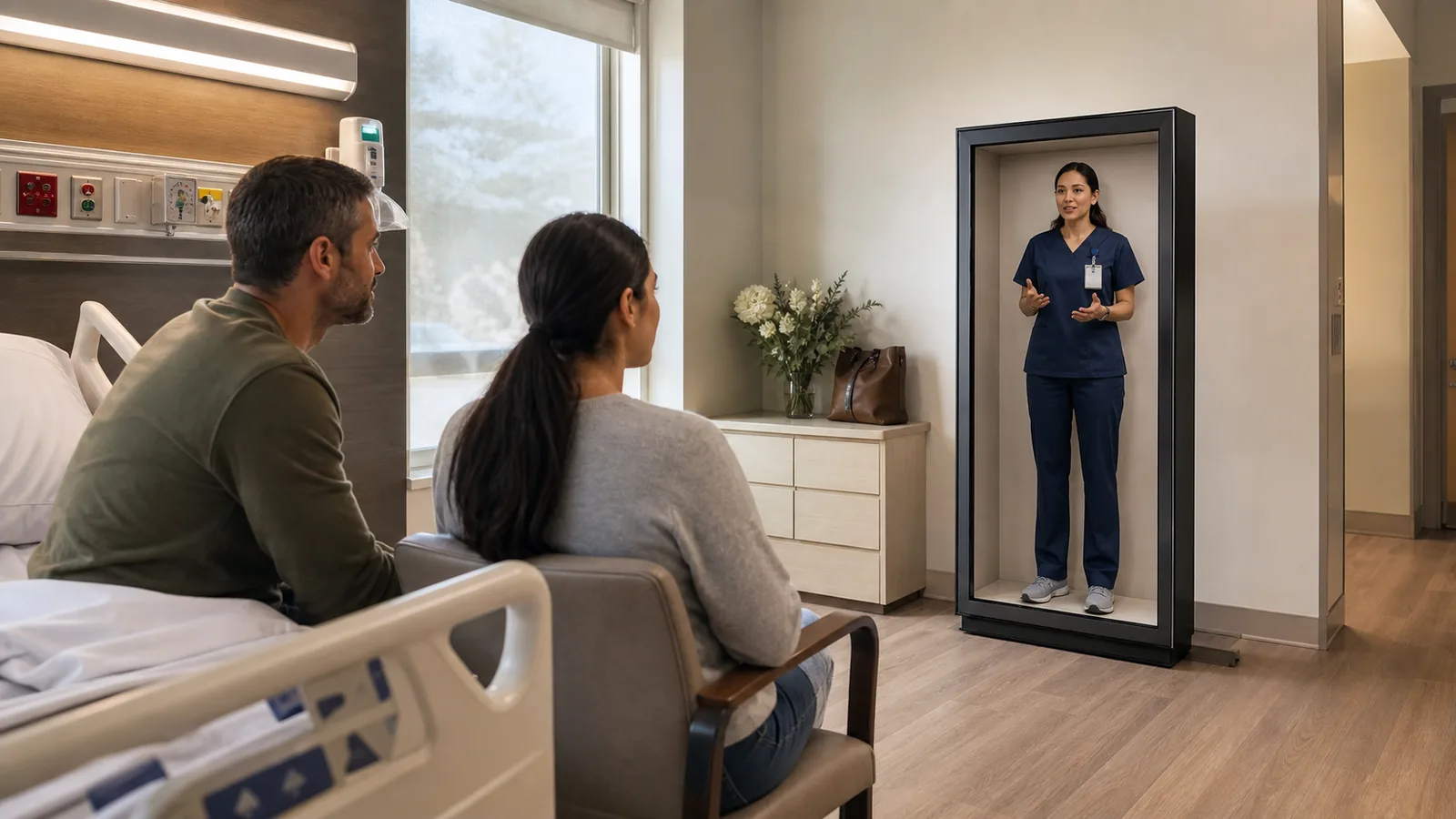
Make approved next-step education easier to understand before a patient leaves.
At a glance
Three decisions that shape the use case.
- 01
Discharge guidance succeeds when the patient and caregiver can explain the plan back, recognize warning signs and know exactly whom to contact.
- 02
Use printed guidance, a portal or a standard call when they provide equal clarity. Use presence when visible pacing, human reassurance, body-scale demonstration or shared family attention adds value.
- 03
The pilot should define a baseline and measure teach-back success, follow-up completion and clinical escalations before anyone treats the concept as proven.
The opportunity
Design for the moment that matters.
What breaks today
Discharge instructions arrive at a stressful moment and are often reduced to paper or a rushed conversation. Important questions surface only after the patient gets home.
The presence pattern
A staff-led or approved digital guide reviews the care team’s instructions, checks comprehension and routes any clinical uncertainty back to a qualified professional.
Design requirements
Make it useful before making it magical.
- 01
State the boundary
Disclose whether the presence is educational, administrative, human-led or AI-assisted and what it cannot do.
- 02
Protect privacy
Minimize collected information, obtain appropriate consent and design the room for confidential conversation.
- 03
Escalate safely
Make qualified human help, emergency guidance and session termination easy to reach.
Operator runbook
Design the complete service—not only the scene.
- 01
Set the baseline
Before launch, define the audience, room, and baseline event this presence changes. Name the owner of each session state and the handoff path.
- 02
Invite with clarity
For the first pilot, make the purpose explicit: why this presence is there, what it can do, whether it is live or AI-assisted, and how a participant exits safely.
- 03
Close the loop
A staff-led or approved digital guide reviews the care team’s instructions, checks comprehension and routes any clinical uncertainty back to a qualified professional. End every session with a visible next action, capture only consented outcomes, and run one short review before expanding to a second site.
Pilot scorecard
Prove a real outcome in the room.
Teach-back success
Define the starting event, completion event and current-workflow baseline for teach-back success. Count only observable outcomes.
Follow-up completion
Review follow-up completion by audience, session stage and operator. Use the pattern to find where confidence is gained or lost.
Clinical escalations
Set a minimum threshold for clinical escalations before launch. Name the owner and recovery action when a session misses it.
Decision gates
Know when presence is—and is not—the answer.
Presence must earn the room
If the same discharge guidance outcome can be achieved by a well-designed phone, kiosk or conventional video call with equal trust and clarity, use the simpler tool.
The boundary must stay visible
Do not launch discharge guidance until participants can identify the role, source, live or synthetic state, information boundary and human fallback without guessing.
The operation must survive novelty
Care teams and patient-experience leaders should be able to run, pause, recover and measure the experience repeatedly. Do not scale while success depends on a founder or engineer standing beside it.
Evidence status. This page is a product-design field brief, not a claim that Reality Relay has already produced the stated customer outcome. Replace the hypothesis with measured pilot evidence before presenting it as proof.
Build the first pilot
Start narrow enough to learn.
For Discharge guidance, begin with one real environment, one defined audience and one repeatable interaction. Establish who operates the experience, what information or tools it can access and exactly when a person must take control.
Reality Relay Platform coordinates content, session state, approved intelligence and operations. Relay Space, Relay Frame and Relay Box give each experience a calibrated physical endpoint at the right scale. The pilot should earn expansion by improving the scorecard above—not by novelty alone.
- Primary audience
- Care teams and patient-experience leaders
- Experience family
- Health & wellness
- First decision
- Choose the room, baseline and accountable operator
- Expansion rule
- Scale only after the scorecard beats the current workflow